

When you have an idea for a mobile app development project, one of the key decisions that you will need to make from the very beginning is the choice of the best programming language. The selected option should correspond to your business needs and technical requirements, including your apps' compatibility with different mobile devices, its performance, and functionality.
In this article, we are going to share the most important information you should know about the top programming languages used for building Android and iOS apps.
Moreover, we will share our practical recommendations on the parameters you need to bear in mind when looking for the right programming language to develop your solution.
The best languages for mobile app development
According to the TIOBE Programming Community index, as of July 2026, Python is the most popular programming language followed by C, C++, C#, and JavaScript.
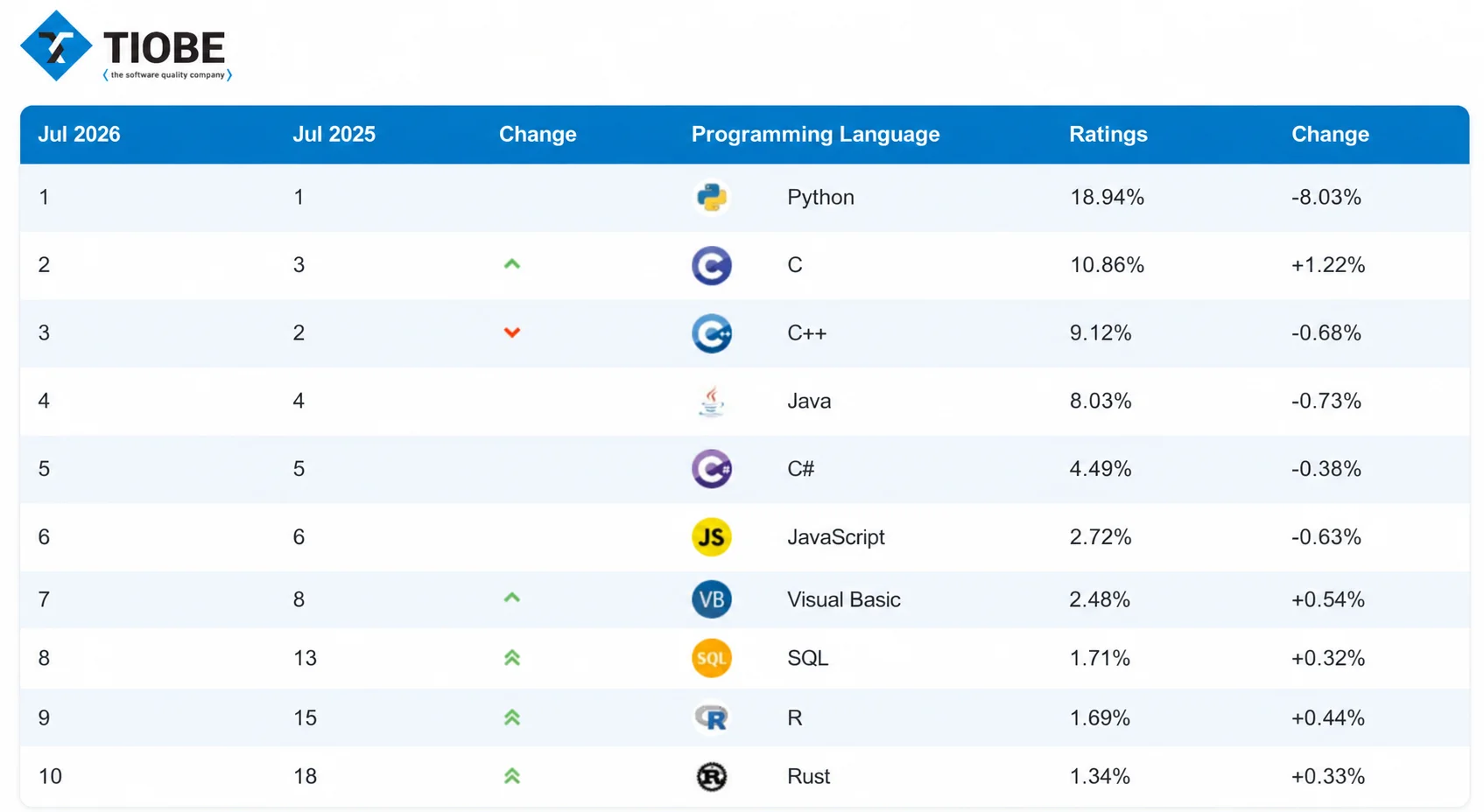
Does this index show that they are definitely the best options for mobile or web application development? And is Python really the most sensible choice for your projects? Well, it depends.
In software creation (and mobile app development is not an exception), it is impossible to provide any precise answers to questions like "Is Python better than Java or C++?" or vice versa.
Such popularity indexes can reflect the demand for this or that technology, as well as the interest from the developers.
However, they can't demonstrate the suitability of any programming language for developing mobile apps or any other solutions launched by your organization. Such decisions should be made based on numerous factors that we will mention further in our article.
But to begin with, let's consider the programming languages that are commonly used in iOS and Android app development. We will talk about their strengths and weaknesses so that you can make a well-grounded choice for your project.
Java: One of the best app development languages
Java is probably the most well-known programming language for mobile software creation. It is still widely used in Android development, though some experts claim that it is already an outdated approach.
Is Java better than Python for app development regardless of the fact that Python is more popular? For some solutions yes. However, to provide an accurate answer, we should analyze the needs of your project.
Java's use cases
Java is best suited for projects that require robust backend logic, reliability, and long-term maintainability.
When can you use this programming language?
- Native Android development;
- Enterprise-level mobile apps;
- Large-scale apps with complex backend requirements;
- Apps needing extensive third-party library support;
- IoT and embedded systems integrated with mobile apps;
- Apps requiring strong security layers
Pros of using Java for building native apps
- Reliability. This time-tested programming language powers millions of apps today.
- Great performance for Android. It runs directly on Android’s virtual machine and is a perfect choice for Android development.
- Massive developer community. Community support and a wide range of available resources greatly facilitate the process of building Android apps.
- Easy scalability. Java is one of the best programming languages as it successfully handles large-scale projects with complex logic.
Cons of choosing Java for app development
- Verbosity. It is required to write more code lines to solve some tasks than in the case of using some other languages.
- Challenges with UI development. This process can be rather cumbersome, especially in comparison to newer frameworks like Flutter.
- Memory management. It consumes more memory resources compared to optimized languages.
- No native support for iOS. This complicates the use of Java for iOS app development.
Python for mobile development
Python is widely praised for its simplicity, readability, and versatility. It powers everything from web development and data science to AI and automation.
But when it comes to languages for mobile app development, Python isn’t always the first language that comes to mind. However, Python can be used for mobile apps as well.
Python's use cases for building mobile apps
Python becomes a good choice for apps that are focused on logic but do not have heavy UI/UX requirements.
That's why it can be chosen for:
- Prototyping and MVP development;
- Data-driven apps powered by data analysis;
- Utility apps like calculators or converters;
- Apps integrated with AI/ML models.
Pros of using Python as a mobile development language
- Simplicity. This language ensures not only easy learning but also faster development. This makes it a great option for rapid prototyping.
- Huge library ecosystem. Developers can turn to the available libraries, instead of building everything from scratch. This possibility is especially helpful for AI, machine learning, and data processing.
- Cross-platform development. Though there are some limitations, code written in Python can be deployed to run apps on both iOS and Android devices.
- Strong community support. Thanks to this, it won't be very challenging to find the required solutions and documentation.
Cons of choosing Python for iOS and Android app development
- Not native nature. When you use Python to write Android apps or native solutions for the iOS platform, they might not feel fully native.
- Performance limitations. Python can be slower for graphics-heavy apps than some other mobile application development languages.
- Fewer experienced Python mobile developers. Most experts who work with Python focus on web development or AI solutions.
Is Python good for mobile app development? Yes, it is but you should clearly understand the cases when its use can be beneficial.
C# for cross-platform development
C# is a modern, object-oriented programming language praised for its simplicity and flexibility. Originally, it was built for Windows applications. However now, it has also become a popular choice for cross-platform apps, games, and enterprise-level solutions.
Use cases: C# in mobile app development
C# is a great fit for projects that prioritize code reusability, cross-platform support, and robust backend integration.
The list of its typical use cases includes:
- Cross-platform mobile apps;
- Games;
- AR/VR apps;
- Enterprise applications;
- Data-driven apps.
Why is C# one of the best programming languages?
- Cross-platform support. You can run your code written in C# on iOS, Android, and Windows.
- Native performance. Xamarin compiles C# to native code. That's why it is a good choice to build Android and iOS applications.
- Large developer community and vast ecosystem. Thanks to this developers have access to huge volumes of valuable information and resources.
- Clean and readable syntax. This makes it easier for teams to maintain C# apps.
Disadvantages of C# for mobile app development
- Large app size. Especially when developers use Xamarin, apps can weigh more than you expect.
- Complications with UI design. This task may require extra work.
- Performance issues. Users may face them in extremely graphics-heavy apps.
- Platform-specific customization. Some features still need native coding per platform.
Swift: The gold standard for iOS development
We have already mentioned a good choice for Android app development. Now it's time to pay attention to another popular mobile platform.
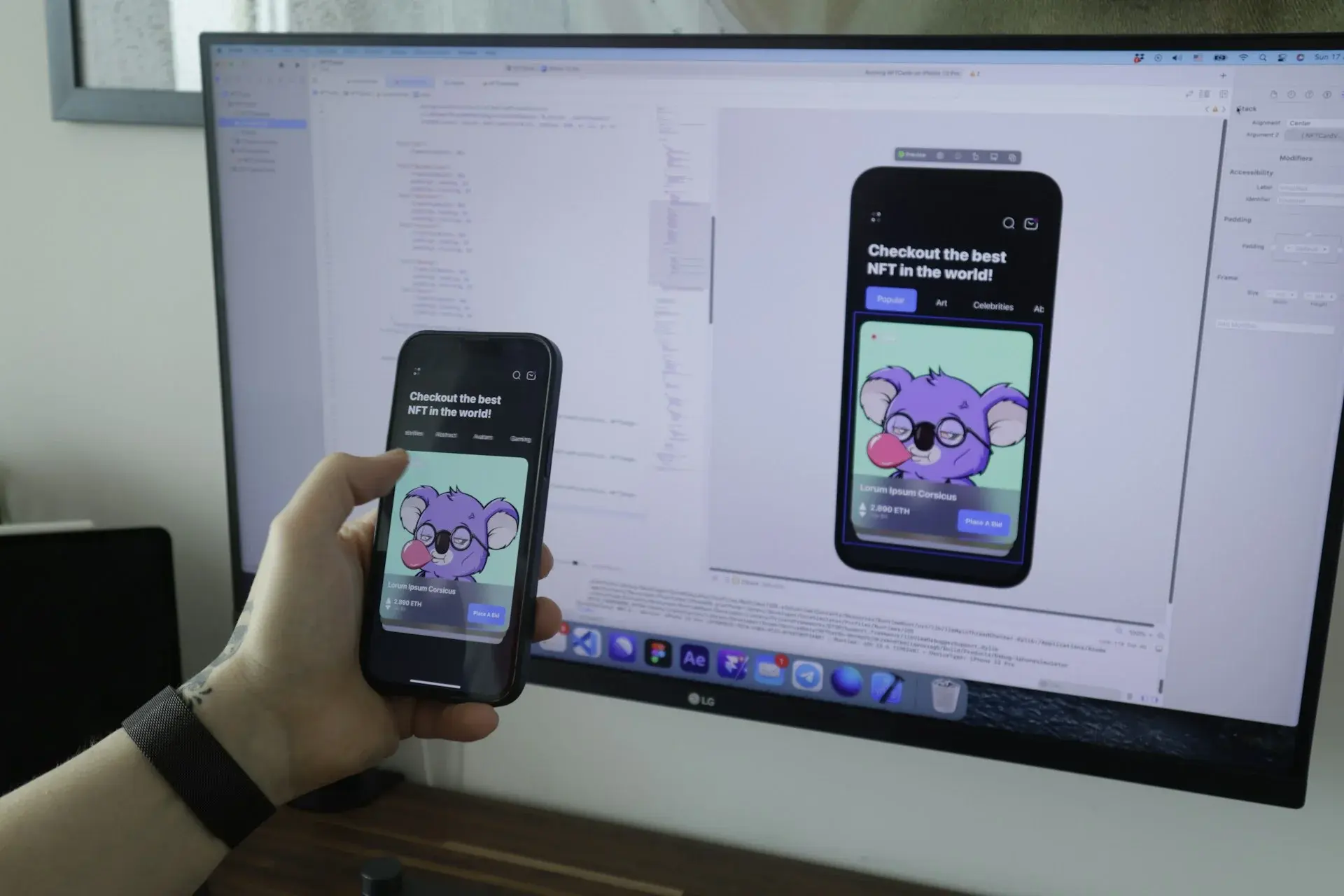
Swift was created by Apple in 2014 specifically for iOS, macOS, watchOS, and tvOS app development. It was introduced as a safer and faster alternative to its predecessor, Objective-C.
When can you choose Swift as a programming language for app development?
Swift can be chosen for any app targeting the Apple ecosystem.
Its most popular use cases are:
- iOS mobile apps;
- iPadOS, macOS, watchOS, and tvOS applications
- Apps that should be seamlessly integrated with Apple hardware and software;
- UI/UX-rich solutions;
- Apps requiring high performance and low latency
- AR/VR apps.
Benefits of using Swift for iOS development
- Native performance. This programming language is optimized for Apple hardware.
- Clean syntax. It is pretty simple to read, write, and maintain.
- Safety-first language. It reduces common bugs, memory leaks, and crashes
- Constantly evolving language. Apple regularly releases updates and enhancements.
Swift's weaknesses
- Apple-only language. It is good for developing iOS apps. But it doesn't natively support the possibility of building solutions for other operating systems. That's why if you are wondering "What language is used for Android apps?", Swift won't be on the list of suitable options.
- Relatively short history. This language for app development is rather young. It means that new features sometimes lack mature documentation
- Larger app sizes. Swift loses the competition with highly optimized low-level languages like C++.
React Native: A reliable mobile app development platform
Of course, mentioning React Native on the list of the best programming languages for mobile apps may be not fully relevant. It's a framework.
Nevertheless, when we are talking about top programming languages and technologies for building cross-platform solutions, it is impossible to omit it.
React Native bridges the gap between mobile and web development. It allows teams to build mobile applications for iOS and Android using JavaScript or TypeScript.
Use cases for React Native
React Native is a feasible choice for those projects where faster development, cost-efficiency, and code reuse are priorities.
Its common use cases include:
- MVPs and solutions for startups;
- Apps of simple or moderate complexity;
- Apps that require shared code between mobile and web;
- Apps that need rapid updates and frequent iterations.
Pros of using React Native for your project
- Cross-platform efficiency. One codebase for iOS, Android, and web applications.
- Faster development cycles. It offers such features as hot reloading and reusable components.
- Good UI capabilities. It ensures a near-native look and feel with proper optimization.
- Strong backing. This language for app development is supported by Meta and widely adopted by top companies.
Cons of choosing React Native
- Performance limitations. This framework is slower for graphics-heavy or complex animations compared with technologies for native iOS or Android app development.
- Native module dependency. Complex features for mobile or web applications may require native code.
- Third-party maintenance issues. Some libraries might not stay up-to-date.
How to choose the right programming language for mobile apps
At Akveo, we have robust expertise in developing mobile apps and other software solutions of different types. This allows us to accumulate deep knowledge of the peculiarities of the available programming languages for mobile and web development.
That's why when our customers come to us for advice regarding the choice of the right tech stack, we can always offer them the best option tailored to their needs.
Step-by-step guide for selecting the best programming language for mobile app development
To make the selection process easier for you, we have prepared the following step-by-step guide. It also includes a list of factors that should be considered.
In general, it doesn't matter whether you are going to build native apps, hybrid apps, or cross-platform solutions. The logic of your analysis should always be the same: you need to verify that the mobile programming language under consideration can perfectly cope with your tasks.
Step 1. Choose the type of your app
Before diving into code, it’s crucial to opt for the platform your app will run on. You can build a native iOS app or a native Android app.
Moreover, there are such options as cross-platform mobile applications and hybrid apps. Different platforms favor different languages.
For example, what languages are Android apps written in? Traditional Android app languages are Kotlin and Java. However, today Java is considered to be a less modern option for the Android operating system, with Kotlin being a trendy choice for many native apps.
When it comes to the most popular programming languages for the iOS platform, they are Swift and Objective-C. Objective-C as an iOS programming language is widely used in legacy solutions.
For cross-platform development, frameworks and tools like Flutter, React Native, and Xamarin can be chosen. They are powered by such mobile app development languages as Dart, C++, Java, Python, and others.
In hybrid app development, you can rely on the technologies that are typically used for creating web applications. As you may know, web developers often work with the most popular programming languages like JavaScript, TypeScript, HTML5 / CSS, and others.
Step 2. Analyze the complexity of your future mobile app
The potential complexity of your app will help narrow down the ideal mobile app development languages in your case.
If you are planning to build just a simple mobile app with basic functionality, there are less strict requirements for its tech stack.
In this case, it can be sensible to choose one of the frameworks for cross-platform apps. It will be a cost-efficient approach as the development process will be less time-consuming than in native development projects. As a result, you will have a mobile app for multiple platforms with lower expenses.
However, for mobile apps with 3D animations, heavy graphics, and AR/VR functionality, you should consider mobile app programming languages that will be able to handle such loads. For instance, it could be Go.
Step 3. Consider your budget and timelines
When it comes to mobile or web app development, time and money are often the biggest constraints. That's why it is highly important to bear these factors in mind.
Native mobile apps are known for their high performance and great functionality. However, native development is a rather time- and effort-consuming process. Moreover, the creation of native apps can become a rather expensive initiative.
If you are building a startup or have a tight deadline for your platform, the use of frameworks for cross-platform apps can become a good solution. This choice can help you significantly reduce the required time and costs.
Step 4. Think about your mobile app development team
The choice of the programming language for your mobile/web apps should also depend on the development team that you are going to work with.
If you already have an in-house team of developers, it will be sensible to choose a tech stack that your specialists are good at.
If you do not have inner resources for your project realization and you will outsource mobile development services, you will have a richer choice. Today, there are a lot of outsourcing companies that work with different technologies.
Nevertheless, we still recommend you pay attention to popular mobile app development languages. In such a case, it will be easier to find good specialists to build and further maintain your software product.
Step 5. Make your mobile app ready for the future
When your mobile app is built and launched, there is still a lot of work for you and your team. Your solution should be supported, updated, and scaled as your user base grows and technology evolves. The choice of the right programming language for mobile app development will greatly facilitate your work in the future.
That's why it is recommended to create mobile apps with a language or technology that has strong community support and releases frequent updates.
It will be a huge plus if a mobile app language is backed by major tech companies. Such factors may indicate that it won't be too challenging to maintain your solution in the long run.
Another point to think about is the need for scalability. The use of a cross-platform programming language can look quite appealing from many perspectives. However, when it comes to scalability native programming languages used in Android and iOS app development will work better.
It doesn't mean that only native apps can be scaled. It is not true. Cross-platform apps can also be expanded. Nevertheless, it could be not the easiest and fastest task for developers.
Is the choice made?
Attentive analysis of different programming languages is a rather complicated process. But it's really worth including it in the preparations for your mobile application development project.
The language you choose lays the foundation for everything that follows, including how quickly your app gets built and how easy it will be to maintain and enhance it in the future.
If you choose the wrong language or framework to build your native or cross-platform mobile apps, it might not seem like a problem at the initial stages of the app development process.
However, over time, the technology stack you commit to will impact the development costs, maintenance complexity, adaptability, performance, and scalability of your solution.
{{cta="/service-blocks"}}
Let's find the best mobile app development language for you
Of course, it can be rather difficult to define the right tech stack for building apps for mobile devices on your own, if you have never done it before. That's why having seasoned experts by your side becomes a must.
If you do not have in-house specialists with relevant skills, do not hesitate to contact us! We are ready to provide any support related to hybrid, cross-platform, iOS, and Android app development, including consulting services.
Our priority is to help businesses find the right solutions that will drive their growth. That's why we deeply study the needs of all our customers before offering them any approaches or programming languages for their projects.
Share your requirements with us to learn more about what we can offer you.