


The development of business apps is traditionally believed to be a time-consuming process that requires huge resources, effort, and exclusive expertise. Nevertheless, this opinion can be true only partially as it refers mainly to custom software development from scratch.
For companies that are looking for optimization of the tasks related to business software, the market can offer low code solutions. If you want to learn more about what they are and what value they can bring to you, we recommend you read this article. We are going to focus on the concept of low-code workflow automation and explain how you can benefit from it.
What is low code automation?
This term refers to the practice of using visual, drag-and-drop interfaces and pre-built components to create apps, automate workflows, and simplify business processes. Such an approach to application development helps to eliminate the need for extensive coding, which leads to significant savings of time and resources traditionally required for building software solutions.
Thanks to these peculiarities of low-code software development, non-technical professionals (also known as citizen developers) along with programmers can design, build, and successfully deploy software solutions to address their business needs.
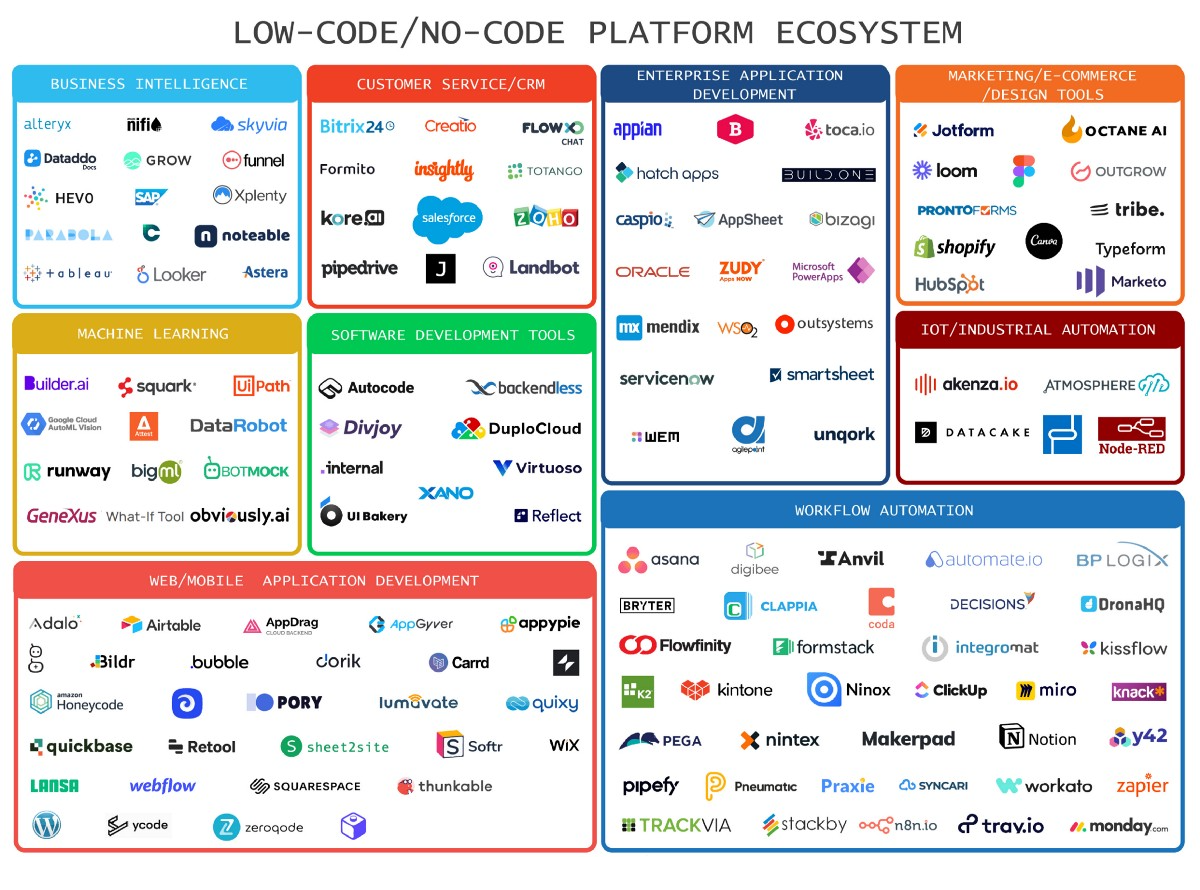
Today there are a lot of low-code application development platforms that can meet the requirements of companies with various expectations. For example, at Akveo, we work with UI Bakery, Webflow, Appsmith, and Airtable. You can read about different platforms of this kind and their functionality in this article.
What is the difference between RPA and low-code automation?
When it comes to optimizing business processes, our clients often ask us about the difference between such approaches as RPA (robotic process automation) and low-code automation.
These technologies have a lot in common as they were designed to improve process efficiency. However, they are not just the same.
RPA is intended to automate tasks by mimicking human actions. In other words, RPA bots replicate how a human would interact with software. For example, they can click buttons, type in fields, copy data, etc. This approach is often used to automate legacy systems that don’t have APIs or direct integrations with external solutions.
Low-code automation presupposes automating business processes with the help of workflow builders and integrations. Low-code platforms are used to create automated workflows across applications. These flows are logic-based and often work behind the scenes, not by mimicking user actions.
Key features of low-code process automation
Want to better understand why low-code software can become an excellent choice for you? It will be helpful to have a closer look at the top features that users of low-code development platforms can leverage.
Drag-and-drop workflow design
With visual workflow builders, even citizen developers can design and automate processes in just a couple of clicks. It will be enough to choose the necessary block and move it to the required area or connect it with another block. Such simple actions can replace many hours of coding.
Pre-built components
Low-code development platforms traditionally offer a wide range of ready-made elements, such as forms, user interfaces, and connectors. Thanks to this, automation logic can be assembled unexpectedly quickly.
Integrations with external systems
Low-code application platforms often provide a lot of opportunities for seamless integration of your business solutions with various external apps and services (databases, CRM systems, collaboration tools, etc.). The connection with these solutions can be performed through pre-built APIs. This means that users do not need to write any complex integration code, which saves development time. Moreover, even citizen developers can conduct the required integrations.
Customization
Such tools have a lot of pre-built reusable components. However, professional developers can still add custom code to meet some specific business requirements. This allows companies to inject their custom business logic into workflows when predefined templates can't cover all the desired use cases.
Scalability of low-code platforms
Applications and workflows built with low-code development tools can be expanded to cope with increased demands and loads. These platforms are usually equipped with all the necessary features and infrastructure for seamless scaling of the created apps.
Collaboration features
The majority of modern platforms for low-code process automation offer convenient features for collaboration between software development and business teams. At the same time, they make it possible to introduce role-based access control, which can ensure proper security. Moreover, version control tools enable teams to revert to previous versions when needed.
Workflow automation
With a low-code application platform, you can automate the assignment of tasks to appropriate users or systems, as well as build conditional logic into workflows. Thanks to this, it is possible to initiate processes with the help of specific triggers, like receiving an email or a form submission.
Monitoring and reporting
Low-code workflow platforms can efficiently track the progress of processes in real time, identify bottlenecks, and help optimize performance. Quite often they also can generate reports and analytics dashboards to provide insights into task completion and resource utilization.

How low-code automation can simplify business processes
To understand better what is low code workflow automation and why it is good for business, let's explore its main benefits.
Streamlined development process
Low-code tools allow businesses to avoid the necessity of writing thousands of code lines to create solutions or workflows. Instead, users of low-code automation platforms, including citizen developers, can rely on pre-built components and visual interfaces to develop and deploy their solutions. As a result, thanks to this approach to app development and process automation, it is possible to solve all the tasks much faster, without traditional coding cycles.
Reduced dependency on IT teams
As even non-technical professionals can easily interact with low-code platforms to build and maintain business solutions, it is possible to eliminate constant IT support.
Increased agility of business processes
Low-code application development enables organizations to quickly adapt to changing business needs as low-code environments allow rapid modifications and iterations of automated workflows. And all this is possible with minimal disruption.
Higher efficiency and productivity
With automated processes, companies can get rid of manual, repetitive tasks, reduce human error, and achieve better efficiency in their enterprise applications, mobile solutions, and other tools. Low-code platforms help automate workflows across departments. This ensures smoother operations and quicker task completion.
Enhanced control and visibility
Low-code automation platforms traditionally include features like dashboards, reporting, and workflow monitoring. It means that companies can gain real-time insights into how their processes are performing. This lets them make more informed decisions, faster define possible issues, and introduce more proactive process management.
{{cta="/service-blocks"}}
Low-code automation: Real-life applications
Today low-code automation is adopted across various industries and domains. Let us mention at least some of them.
Banking and financial industry
Banks and organizations that provide financial services can use low-code platforms to automate customer onboarding tasks and other related business processes. This helps to reduce the time that is required to open accounts, perform KYC checks, and approve loans. Workflow automation also reduces the risk of human error and improves customer experience.
Moreover, banks can rely on low-code automation to build systems that continuously monitor transactions for fraud.
To see how it might work, check out our project – Billing Application for SaaS Company.
Healthcare
With low-code tools, healthcare providers can automate patient registration, appointment scheduling, and follow-ups. This not only improves the accuracy of patient data but also decreases administrative workload.
In their turn, insurance companies can utilize low-code tools to automate claims submission and approval processes, which enables faster decision-making.
Retail and eCommerce
Low-code software can be helpful for automated inventory management. For example, they can trigger reordering when stock runs low.
eCommerce businesses can also build low-code applications to organize support workflows and introduce personalized marketing campaigns based on customer data. See how we did it for one of our clients, a gifting marketplace.
Government and public sector
Low-code platforms can be applied to build and automate citizen service portals that deal with paying taxes or accessing public records. Government agencies can streamline many document-heavy processes, for example, application reviews and regulatory filings, to reduce delays and improve efficiency.
Education
There are also a lot of use cases for low-code platforms for educational institutions (check one of our cases – Retool CMS Marketplace for School Programs). They can introduce specialized solutions built with low-code application development tools to work with student admissions, enrollment, and financial aid processes. They can also automate course creation, class scheduling, as well as student attendance tracking.
When it comes to interaction with students, low-code solutions can also be used to collect and analyze their feedback. This helps schools and universities better understand student needs and improve the quality of education.
For more use cases of low-code platforms, you can also explore our case studies.

Low-code automation: Challenges and considerations
At Akveo, we have been successfully working with low-code solutions for quite a while. This allows us to accumulate unique expertise in this domain. Despite the fact that we see a lot of benefits in this approach to building business apps, we always stay objective. Such solutions also have some limitations and we always warn our clients about them when they turn to us for low-code consulting services. That's why if you are considering the use of low-code tools, it will be useful for you to think about possible pitfalls in advance.
Potential customization limitations of low-code solutions
Low-code platforms often provide a wide range of predefined templates and components that can be customized. Nevertheless, the degree of changes that can be introduced is usually limited. These issues are obvious when it comes to complex or unique business requirements. That's why organizations with highly specific needs might find it difficult to implement features that are not included in the platform's native capabilities.
Integration challenges
As a rule, low-code tools provide seamless integrations with the most commonly used business tools and services via APIs. But if you rely on some legacy systems or not very popular solutions in your work, it can be rather challenging or even hardly possible to integrate them. It means that before making a final choice, businesses need to ensure that the low-code platform offers robust integration options and check whether it will work with their tech ecosystems.
Vendor lock-in of low-code automation tools
Many low-code automation platforms are proprietary. It means that applications created within them can run exclusively on the low-code platform itself. As a result, even if a company needs to migrate it away, it may be too hard to do it. Given this, we always recommend companies opt for platforms that provide flexibility and allow users to export and import their apps.
Security risks of low-code automation platforms
Of course, today a lot of high-quality no-code and low-code automation tools introduce strong security measures. However, these measures may not be as robust as in custom applications. Especially, it may be relevant in relation to sensitive data and cybersecurity threats. It means that while analyzing different options, you need to make sure that the platform adheres to stringent security practices and offers role-based access, encryption, and audit logs. Moreover, different jurisdictions often have their own specific compliance requirements. And the platform under consideration should meet them.
Performance issues
Applications built using low-code automation platforms may face performance limitations. Such problems may arise especially in the cases of inefficient code generation by the platform or a lack of control over the back-end infrastructure. To avoid this, it is vital to choose platforms that allow code optimization and performance tuning.
Cost implications in the long-term
Low-code automation tools do not require significant upfront investments. Moreover, they are generally considered to be rather cost-effective, especially in the short term. However, licensing and storage costs can increase when you scale your solutions. It is always necessary to perform a thorough cost analysis. You should take into account not only the initial investments but also the long-term costs, including maintenance. If you need any assistance with this, you can either turn to us for low-code consulting services or find helpful information on our blog. In one of the recently published posts, we explained the details of Retool pricing.

Final word
For businesses that are looking for the most feasible ways to automate their workflows, it is vital to analyze different options. While considering low code app development, it is necessary to answer not only the question “What is low code automation?” but also “What benefits can it bring to us?”. It is crucial to understand all the pros and cons of this approach to organizing the development process and be ready for the potential limitations of low-code automation tools.
Looking for the most appropriate solutions for your business? Do not hesitate to contact our low-code consulting experts and get valuable recommendations.