


Well-organized processes are often viewed as a key to overall business success. It's rather simple to handle just a couple of straightforward workflows. However, the issue is that with your business growth and expansion, it will become more and more challenging to deal with all the processes you may have. That is when efficient business process management (BPM) should enter the game. And the task for every company is to find the most feasible and appropriate way to introduce it.
In this article, we would like to talk about low-code BPM and its peculiarities. Moreover, we will explain how to work with low-code platforms to leverage all their benefits for workflow automation.
What is low-code BPM?
Let’s start with the most basic things that you should know. The term low-code BPM describes the use of low-code platforms to design, automate, monitor, and optimize business processes with minimal coding.
Such low-code BPM platforms usually provide a visual, drag-and-drop interface and pre-built components. These elements enable both technical and non-technical business users without coding knowledge to create and manage workflows efficiently.
Key benefits of low-code BPM platforms
Rapid development process
Low-code development platforms ensure rapid process creation and iteration. The tasks that may take a couple of months in the case of traditional development can be fulfilled in a couple of days (and sometimes even hours).
Easy maintenance of low-code BPM solutions
Simplified process design tools provided by low-code BPM platforms mean fewer coding-related bugs and less complicated updates.
Cost-efficiency of low-code BPM platforms
The use of low-code solutions for implementing BPM tools requires less specific expertise than traditional software development. As a result, businesses can minimize their reliance on external or internal IT teams, which allows them to optimize their tech-related expenses.
Flexibility
Low-code platforms and BPM solutions make it easy to modify workflows when your business requirements evolve.
Improved efficiency
Thanks to the seamless automation of routine tasks, you can streamline your business operations and reduce the risks of human error.
Challenges of using low-code BPM platforms
Of course, low-code platforms that allow you to automate and optimize business processes have a lot of advantages. However, their use is also associated with a row of pitfalls that you should be aware of in advance. Without any doubt, they shouldn't discourage you from using low-code BPM tools. Nevertheless, they may require some extra effort and preparation from your side.
Limited customization of low-code BPM tools for complex and highly unique processes
Low-code BPM platforms are excellent for standard workflows. Nevertheless, they may struggle with highly complex, non-linear processes, especially if they require integration with legacy systems or deep customization.
Scalability of low-code BPM platforms
Low-code BPM tools speed up development. But when it comes to scaling business processes as they grow in complexity, you may face difficulties. Performance bottlenecks and architectural limitations may appear with larger deployments.
Limited flexibility in logic
Advanced business rules or conditional logic can be hard to implement with low-code BPM tools due to the constraints of visual builders. Some low-code BPM platforms don’t offer enough freedom for companies without diving into code.
Vendor lock-in
Many low-code BPM platforms use proprietary languages or structures. As a result, it can be very difficult to migrate your BPM tools to another platform.
Collaboration gaps between business and IT teams
Such platforms promise to bridge the gap between developers and users without tech skills. But misalignment can still occur. You should be ready for that. Business users may often overestimate the possibilities of low-code BPM platforms, while IT teams may not be fully satisfied with the security of the offered low-code BPM tools or architectural decisions.
How to automate processes with a low-code BPM platform
Some steps and approaches can greatly differ based on individual requirements. Nevertheless, there is also a row of common tactics for implementing BPM solutions. They will be helpful for any business striving for optimization with the help of low-code BPM tools.
Step 1. Identify key processes for automation
Even before considering different low-code BPM and app development platforms, you should understand what processes should be automated first.
You need to prioritize high-impact areas. We recommend you focus on repetitive and the most time-consuming tasks or processes with bottlenecks.
It would also be a good idea to involve employees from different teams in the discussion. It will help to learn about some pain points that may have gone unnoticed. The more you know about the existing processes, the better your automation efforts and BPM solutions will align with business objectives.
Moreover, do not forget to think about feasibility. Sometimes it is not sensible at all to automate some separate processes. It happens when workflow automation requires a lot of time and money because of challenging customization, but the value of the outcomes is too low.
Step 2. Select the most appropriate low-code BPM software
Today, this development approach that doesn't require extensive coding is gaining popularity. More and more businesses across various industries show their interest in using low-code BPM tools to build their software solutions, including web and mobile apps, quickly and efficiently. Given this demand, it is quite natural that a lot of new tools are regularly introduced to the market.
With our experience in building custom apps with the help of low-code platforms, we are absolutely sure that it is impossible to find just one low-code BPM tool that will be appropriate for everyone. However, it is possible to find a platform that will be the best one for your business.
It means that before making your choice, you should consider the following parameters:
- The key features of the platform;
- Scalability;
- Customization and flexibility;
- Available integrations;
- Pricing;
- Users’ reviews and reputation;
- Community support.
It’s very important to verify that the chosen low-code BPM platform will not only align with your business processes and meet your current requirements but will also support your growth in the future.
At the same time, just choosing the most expensive one with the longest list of features won’t be a good approach. You do not need to overpay. And you do not need to opt for a low-code BPM platform intended for huge enterprises with complex processes when you have a startup or a very small company.
If you are now considering different low-code BPM tools to streamline operations, it will be helpful for you to read about Retool and its alternatives like UI Bakery, Appsmith, Budibase, and others.
Step 3. Map out your business processes visually
To better understand and, consequently, manage and automate your business processes, you need to create their visual representations. To do it, you can rely on process modeling tools that low-code app development platforms typically can offer.
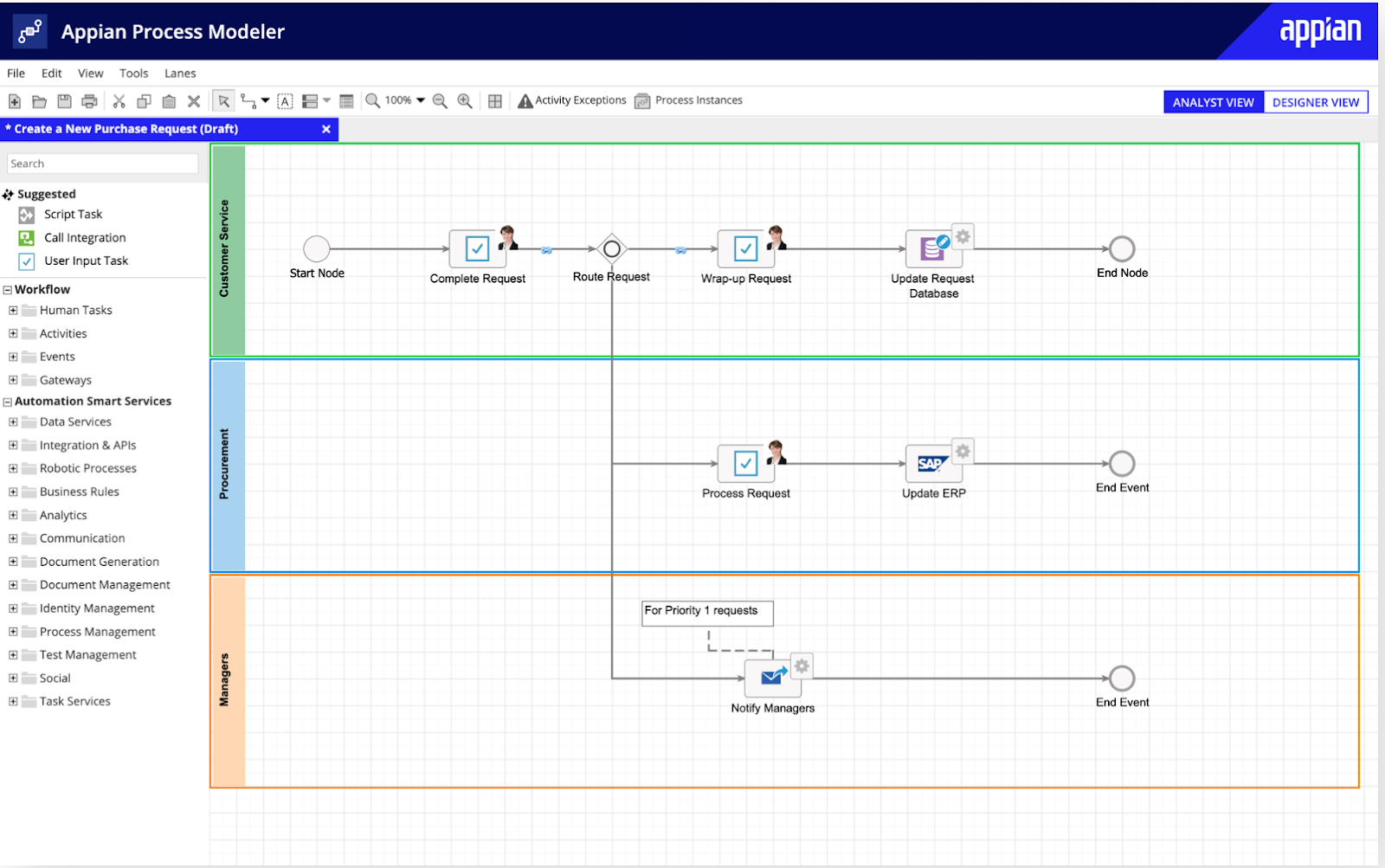
While working with such low-code tools, you need to clearly identify the process start and end, decision points, and potential exceptions.
Step 4. Integrate low-code BPM solutions with existing systems
To make sure that all your automated workflows will function well, you need to integrate the low-code BPM platform with your existing tools and systems.
A lot of low code application development platforms offer native integrations with a variety of commonly used business tools and services. Modern software of this kind can also be equipped with special pre-built connectors that facilitate API integrations with databases, CRM, ERP, or HR systems. For example, on our blog, you can read about the integration capabilities that Retool provides.
Thanks to such integrations, you can enable data flow across platforms, avoid silos, streamline operations, and reduce errors in data validation and transfer.
At first, when you are just starting to implement BPM solutions, it can be rather difficult to imagine what integrations you need. Nevertheless, when you start planning your workflows, everything becomes clear. Just think about the data that you traditionally rely on for this or that task. For instance, when you work with order processing on your eCommerce website, you need to have inventory and accounting data at hand. That’s why, for automating this business process, you need to ensure the smooth integration of low-code BPM solutions with inventory and accounting systems.
Step 5. Start small, scale gradually
Quite often, businesses want to implement business process automation as soon as possible. They believe that if they invest a huge amount in a big BPM system just at once, they can finish all the work rather quickly. And further, they will have the possibility to relax and enjoy the benefits in the long run. Unfortunately, it doesn’t work this way. Instead of enjoying quick results, you may have a new range of issues with your business processes that you would never have if you hadn’t automated everything together.
We strongly recommend you begin with a small pilot project to test the effectiveness of automation. To do it, you need to:
- Choose a single, well-defined process;
- Focus on its automation and optimization;
- Monitor results, refine created workflows, and gather user feedback for further improvements.
When you are satisfied with the results, you can proceed to the next step and scale the solution to other processes and routine tasks to build a full-scale BPM system.
{{cta}}
Low code BPM practical recommendations
A well-thought-out and structured plan for managing business processes with low code application development software is very important for achieving the desired results. However, there are some other things you need to know before starting your process automation project.
Let us share the best practices and recommendations that we consider to be crucial based on our experience.
Compliance and security
All automated processes must adhere to compliance requirements. Given this, you should embed string data privacy controls, especially for sensitive information. Always carefully check what regulations are in force in your region. Regular reviews of security settings will help to prevent unauthorized access.
User experience first
Always bear in mind that process management and automation tools should simplify workflows, not complicate them. Interfaces should be intuitive and require minimal training to deal with them. It is recommended to continuously collect feedback from employees to improve the solution’s usability. If any BPM tools slow down the work of your team, such solutions should be eliminated from your processes or replaced with new ones.
Improvements and optimization
We recommend you define key performance indicators (KPIs) to track automation success. What parameters can be evaluated? Everything depends on the specificity of the processes that you deal with. For example, they can reflect time savings, error reduction, or user satisfaction. Low-code BPM platforms typically provide dashboards and reports on the performance of your applications and workflows. They make it easier to track these metrics.
AI-powered analytics
Low-code platforms often support AI-driven features. You shouldn’t miss this opportunity to leverage the power of this technology. You can introduce intelligent automation for decision-making, such as routing tasks to the right team based on workload. It would also be quite sensible to use advanced analytics tools to identify areas for further improvement, as well as to predict and mitigate bottlenecks.
Efficient collaboration between IT and business teams
Low-code BPM platforms empower citizen developers, even if they do not have any coding knowledge at all. The contribution of business users shouldn’t be underestimated. That’s why it is vital to train your teams on the capabilities of BPM services and their limitations. However, IT oversight and support often remain critical.
Bottom line: Should you consider low-code BPM tools for your organization?
Traditional tools for business process management and automation often require extensive coding and development expertise. As a result, their use leads to long implementation times and higher costs. Low code BPM solutions eliminate such challenges. This approach greatly democratizes process design and empowers organizations to:
- Respond quickly to their changing needs;
- Engage business users in the development of software solutions and automation efforts;
- Scale automation of business operations across departments without overburdening IT.
Thanks to all the benefits of low-code app development platforms, they can fully transform how businesses streamline operations and implement BPM solutions, enabling agility and innovation in a highly competitive landscape.
Need professional consulting services or any development assistance in your low-code BPM projects? At Akveo, we are always open to cooperation. Just let us know how we can help you, and we will offer the best solution for optimizing your business processes with the help of advanced BPM systems. Contact us now!
{{cta="/service-blocks"}}