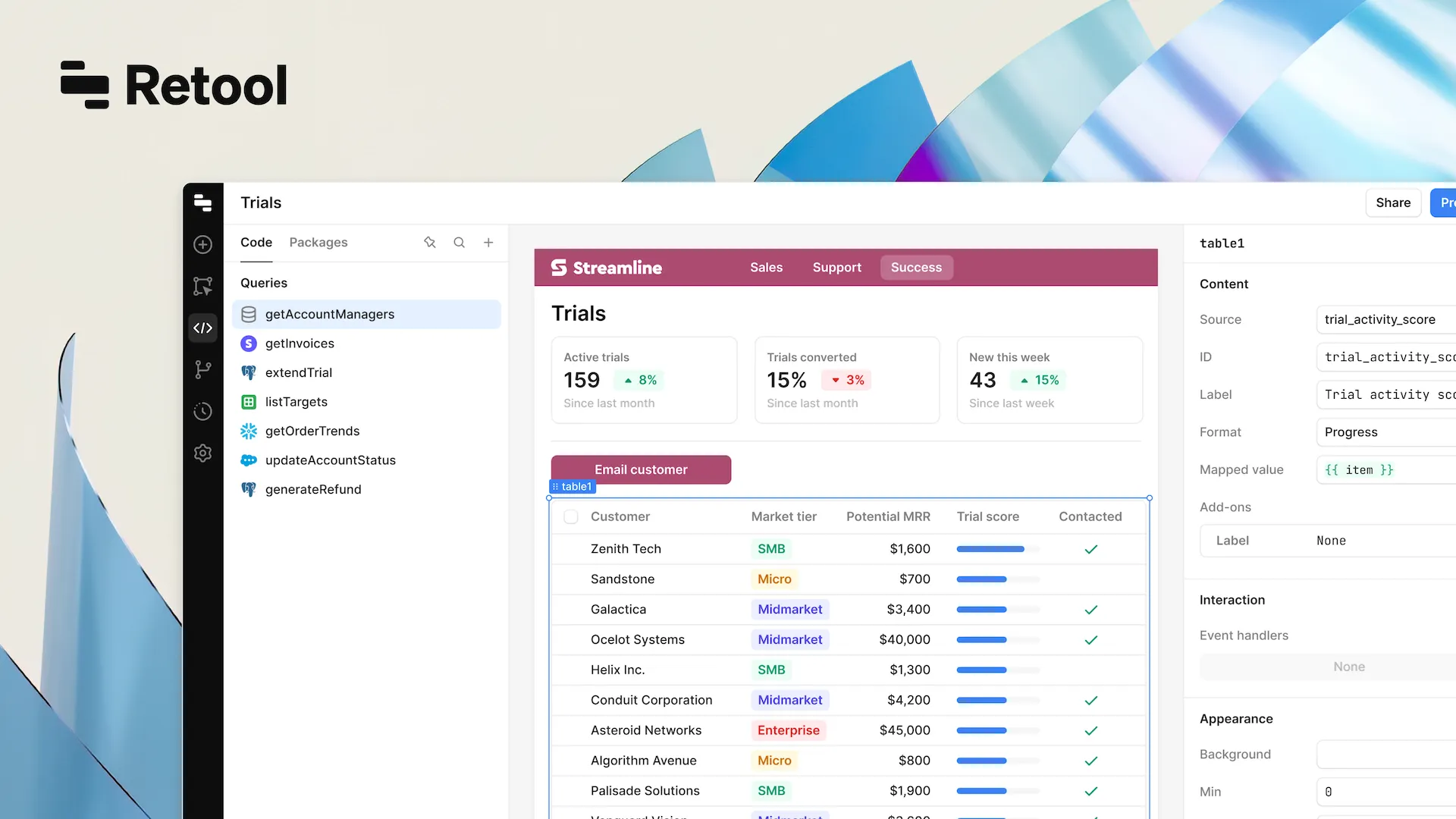



The role of software solutions in the successful performance of businesses can't be underestimated. Well-thought-out applications can significantly streamline and facilitate a lot of everyday tasks for different teams, help to increase overall productivity and minimize the risk of human mistakes. Nevertheless, to leverage all these opportunities, companies need to opt for the right solutions and the right approaches to their development. The creation of apps should be smooth, well-organized, and feasible from the financial perspective. And here's when the low code vs traditional development dilemma enters the game.
Traditional development: What should you know about it?
Before we proceed to discuss the peculiarities of low code development, let's focus on the benefits of the traditional development approach.
Custom software development is a term used to describe the process of designing, coding, deploying, and maintaining software solutions tailored to the specific needs of particular users. This approach is often named as an alternative to using off-the-shelf business apps that offer only standardized functionality and integrations.
Traditional software development presupposes building solutions from scratch, which allows developers to satisfy all the unique requirements of businesses.
Let's take a closer look at the advantages and disadvantages of this approach. This will make it easier for you to find the right answer to the low code vs traditional development question.
What are the benefits of traditional software development for businesses?
High efficiency
Solutions are specifically built to meet all business needs of an organization. This can ensure they fit the exact workflow and seamlessly integrate with existing processes. As a result, such apps can demonstrate outstanding productivity and efficiency.
Scalability
Custom solutions can be designed with scalability in mind. That's why businesses can easily expand or modify their features. Moreover, there is no need to switch to new systems when companies scale their activities.
Competitive advantage
Custom software is unique and can provide businesses with a competitive edge. Such apps can offer features and capabilities that are not available in standard software.
Seamless integration and compatibility
When you are building software from scratch, it can be designed to easily integrate with all your existing tools, databases, and workflows.
Security
When businesses opt for traditional development, they can power their solutions with their own security protocols. This will allow them to safely protect apps against all major vulnerabilities.
Full control
With custom development, companies will have full control over their software. It means that they can modernize or discontinue it when they have such a necessity. Their decisions won't be blocked due to dependence on third-party platforms.
What are the disadvantages of traditional development?
High initial costs
As a rule, custom app development may require significant upfront investments. The major part of them will be related to developers' salaries and associated costs.
Development time
Traditional development from scratch is a rather time-consuming process. It involves a lot of steps, such as planning, coding, testing, and deployment. The implementation of off-the-shelf solutions and low code apps takes significantly less time.
Complexity of traditional development methods
If you choose this approach for creating your apps, you need to cooperate with professional developers. You can either hire in-house experts or work with external specialists. People without professional skills and knowledge won't be able to write high-quality working code.
Maintenance and support
After the launch of your custom solution, it's necessary to continuously monitor its performance and regularly update it. These activities require extra expenses.

What is a low-code development approach? Basic info
Unlike traditional development, the creation of apps with the help of low code application platforms requires minimal hand-coding. This approach enables users to build applications through graphical user interfaces, drag-and-drop features, and pre-built templates. Such elements greatly reduce the complexity of traditional coding.
One of the key peculiarities of this approach is that low code digital transformation can be managed not only by professional developers. Non-technical users (often called "citizen developers") can also actively participate in such projects.
To make the right choice between the low code vs traditional approaches, you need to consider the benefits and pitfalls of both of them. And now it's a turn for low code application development.
What is the difference between low-code and no-code development?
Quite often in the context of low-code vs traditional development comparison, low-code development platforms are considered together with no-code solutions. And it makes sense to do this as these approaches have much in common and can be viewed in contrast to traditional app development.
They both allow teams to build their custom apps with the help of drag-and-drop interfaces, which helps to minimize or even fully eliminate the need for manual coding. This greatly facilitates and streamlines the development process and allows businesses to overcome the majority of challenges associated with traditional programming.
The key difference between no-code and low-code tools is related to the possibility to enhance the created web or mobile apps with custom code.
No-code platforms are designed mainly for people with no programming expertise. Their visual interfaces let users create fully functional applications without writing a single line of custom code. They have everything that you may need for developing apps of different types, including pre-built templates and integrations. Such platforms often become a good choice for individual business users and non-technical teams that have no experience in working with traditional coding environments.
For instance, such a software development approach could be perfect for an HR team that wants to launch a custom employee onboarding portal with minimal (or zero) support from the side of IT experts.
This method of developing web apps and other solutions may seem to be very appealing. However, when it comes to complex applications, your team may face serious limitations. For more complex software solutions, at least minimal coding becomes a must. And here's when low-code platforms enter the game.
They also may offer a wide range of pre-built components for desktop, mobile, and web apps. However, developers are also provided with the possibility to rely on the knowledge of supported programming languages and traditional coding to build more powerful and feature-rich low-code solutions.
The choice between no-code and low-code development platforms should depend on your specific goals, the technical expertise level of your team, and the complexity of the app you need to build.
- No-code tools are a good option if you want to empower non-technical team members to build internal tools or automate workflows quickly.
- Low-code platforms will be a better solution if you need flexibility, customization, or want to develop complex applications tailored to your needs. And what is highly important here, all this will take less time than traditional coding.
What are the advantages of low-code software development?
Rapid development
Instead of the weeks and months that are required for the traditional development process, you can build your low-code applications in a couple of days or even hours. Pre-built re-usable components and templates offered by low-code platforms will help you streamline app creation. It is especially beneficial when you need to respond quickly to market changes, user feedback, or internal business needs.
Lower costs
Low code digital transformation is based on the principles of rapid application development. As fewer working hours are required, the overall cost of building apps becomes significantly lower. Moreover, with such an approach, you do not need to hire a full team of highly specialized developers. The choice of low-code development can help you achieve real savings, especially when you compare your investments with the budgets required for traditional development projects.
Involvement of citizen developers
Even non-technical users can build and update apps with low-code tools. It allows businesses to easily introduce the required changes in their solutions and workflows without waiting for the help of professional developers. As a result, business teams can implement changes on their own without waiting for the development team. Moreover, with low-code tools, day-to-day workflows can be improved directly by those using them, which is also quite important for ensuring the highest efficiency of these workflows.
Rapid iterations
Thanks to the minimal coding that is typical for low-code development, it doesn't take long to prototype, test, and deploy changes. The low-code approach helps businesses seamlessly adapt to quickly changing requirements.
Enhanced collaboration
Low-code development is more inclusive than traditional custom development. The creation of low code apps makes it possible for technical and non-technical teams to easily cooperate. Direct communication between all specialists ensures that applications meet all their specific business needs.
Easier maintenance
It is not very challenging to maintain such apps as low-code platforms usually provide updates, fix bugs, and address scalability concerns. Your developers won't be responsible for that.
In one of our previously published articles, we talked about different low-code development platforms, their features, and benefits. You can read about Retool, Appsmith, UI Bakery, and other tools by following this link.
What are the disadvantages of low code application development?
For the correct choice in the low code vs traditional development dilemma, you need to have detailed info about the weaknesses of both approaches. Here are the aspects in which low-code tools fall behind
Limited customization
Though the majority of low-code platforms provide some customization possibilities, they are not limitless. That's why for building highly complex or specialized apps with such tools, developers may face limitations posed by predefined components and templates. The only way out of this situation is to turn to manual coding and traditional development methods.
Vendor lock-in of low-code solutions
Custom traditional development provides businesses with full freedom and control over their solutions. With the low-code approach, organizations can become dependent on the chosen platforms. As a result, it can be difficult to switch to another tool. Moreover, migrating apps outside the low-code development platform's ecosystem may require significant effort.
Security and compliance
Some platforms for low-code development may not be appropriate for highly regulated industries like finance or healthcare in terms of security and compliance concerns. That's why businesses should choose platforms for building their apps with diligent attention. It's always necessary to check whether the tools under consideration fully meet the regulatory requirements in the particular markets. For some highly regulated domains, traditional coding will still be a better option than low-code app development.
Performance issues of low-code apps
You can use low-code platforms to build solutions of different types. But you should bear in mind that highly complex apps might experience performance issues.
Scalability limitations of low-code platforms
As well as in the case of customization questions, low code applications may be not as scalable as custom software products. That's why this approach is not always the best choice for building enterprise-level solutions or apps that need to deal with complex data processing. Given this, it is recommended to study the capacities of each low-code platform before choosing it for your business.

Low code vs traditional development: Comparison
Low-code and traditional development represent two distinct approaches to building business apps. We offer you to compare them based on the important criteria.
Speed of development
Traditional development involves writing code from scratch. This is a time-consuming process.
With pre-built components, drag-and-drop interfaces, and visual workflows, low-code platforms help to reduce development time. Users can create fully functional apps in days or weeks, depending on complexity.
Development cost
Traditional coding takes longer and typically requires a larger team of developers with specialized skills in comparison to low-code development. This leads to higher upfront costs.
The faster development time and reduced need for specialized developers result in lower expenses. As for the use of low-code platforms themselves, access to them is offered in accordance with a subscription-based model. As a rule, they have several pricing tiers that address the needs of different businesses. For example, on our blog, you can read about Retool pricing.
Flexibility and customization
Custom development ensures complete control over the application's architecture, design, and functionality. Developers can tailor the app to any needs of your business.
Low-code platforms have predefined components and templates that may restrict advanced customization. It can be difficult to implement specialized or highly unique business logic.
Maintenance
Businesses have full control over the maintenance of their custom apps. The development team must handle bug fixes, updates, and all changes in technologies.
In the case of low-code development, the platform usually handles all routine updates and infrastructure maintenance. Nevertheless, businesses have limited control over updates. It means they may face breaking changes or downtimes.
Integrations
With the traditional development approach, experts can create custom integrations with internal systems, APIs, or third-party services to address the exact specifications of the business.
With low-code solutions, the situation is rather complicated. On the one hand, a lot of low-code platforms come with pre-built connectors for common services like databases or cloud platforms. With such integrations, it is absolutely simple to connect your apps to different systems.
On the other hand, such possibilities in low-code development are limited. And it may be very difficult or even impossible to integrate your low code apps with some less commonly used tools or legacy systems.
Skill requirements
The traditional approach requires proficient software developers. They should be skilled in working with programming languages, frameworks, databases, and various development tools.
Low-code platforms are designed in such a way that even non-programmers can build applications. But for non-technical users, it may take longer to learn the functionality of such platforms and understand their logic. For more complicated projects it's actually better to find an expert, for example, if you work with OutSystems, Appsmith, Retool developer might be a big help to implement everything you are seeking for.
Final verdict: Low code vs traditional development
When our customers come to us with questions about what to choose: low code vs traditional development, we can't provide any precise answer just at once. At Akveo, we have rich expertise in both custom and low-code software development. And we know that both traditional coding and low-code app development have their pros and cons. That's why each case should be viewed individually. This means that without a deep analysis of your needs, requirements, and the existing IT infrastructure, it will be impossible to make the right choice.
Given the strengths and weaknesses of both approaches, it is possible to define cases when each of them may bring the highest value to your business.
Low code development can be chosen for:
- Projects with budget constraints (in the low-code vs traditional development comparison, low-code turns to be a far less expensive option);
- Projects with frequent iterations (low-code development will allow teams to introduce changes fast);
- Standardized use cases as platforms for low-code development offer templates that make deployment lightning-fast;
- Companies that want to involve non-technical team members in working with software;
- Applications that are not highly complex or performance-intensive;
- Temporary or short-term solutions like apps for events or campaigns;
- Businesses that are interested in rapid application development;
- Companies that are not ready to invest in traditional coding projects at the moment;
- Teams with limited development resources.
Traditional development is best for:
- Large-scale solutions with unique requirements;
- Companies that want to have extensive customization opportunities and full control over their solutions, which is not available in low-code development;
- Projects that require deep integration with legacy systems;
- Businesses with long-term investment strategies in software;
- Teams that are looking for data ownership and vendor independence (such options are not available in the case of low-code development);
- Companies that already have experts in traditional coding or are ready to hire them;
- Businesses that need scaling across multi-tenant or global infrastructures (this is not possible for low-code development projects).
{{cta="/service-blocks"}}
Need a Retool developer or a consultant for another low-code platform to understand which approach you should opt for? We are here to help you make the right low code vs traditional coding choice. Just contact us and we will get back to you as soon as possible.